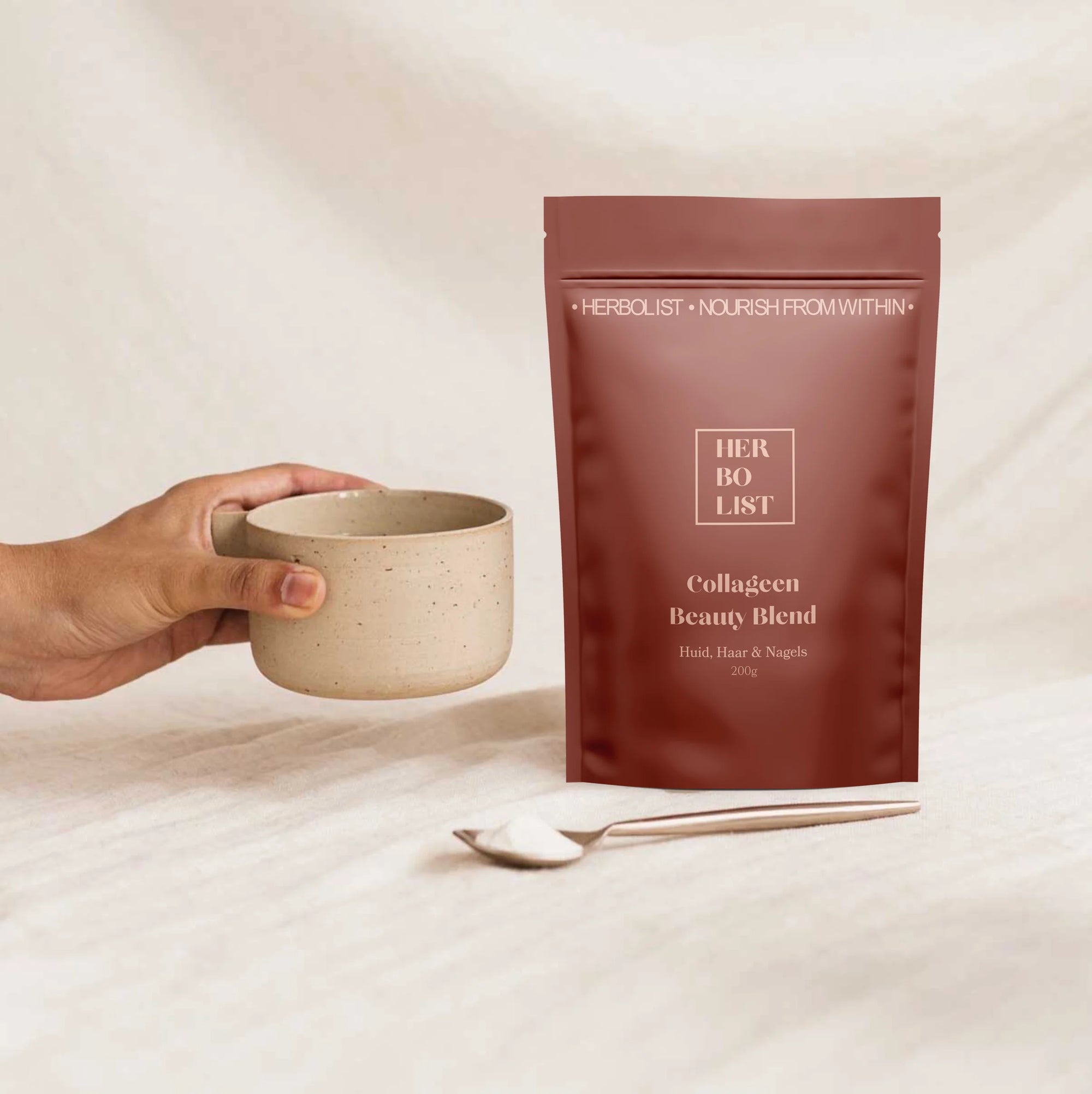


Collagen is a popular supplement, as we at Herbolist know all too well. Herbolist collagen powders are primarily purchased for skin, hair, and nails. But how much do you actually need to notice a difference?
The short answer: the ideal collagen dosage varies by person, goal, and type of collagen. This article explains exactly what collagen is, when to use it, which form works best, and of course, how many milligrams of collagen per day is optimal for you.
What is collagen?
Collagen is a protein that occurs naturally in your body. It provides strength and elasticity to your skin, tendons, bones, and joints. But here's the bad news: as you age, your collagen production decreases. You may notice this in the development of wrinkles, less flexible joints, or dull hair.
There are several types of collagen, each with its own function. Type I is mainly found in skin and bones, type II in cartilage, and type III in organs and blood vessels. Most supplements focus on types I and III, as they are most important for your skin, hair, and nails.
Most collagen powders are usually made from bovine or fish collagen. There's also a significant difference in quality, as the best supplements are made from hydrolyzed collagen. Hydrolyzed means the collagen is smaller, making it easier for your body to absorb. This is also called hydrolysate or collagen peptides.
How much collagen powder per day?
The optimal dosage of collagen powder depends on your goal. For general skin improvement, 2.5 to 5 grams per day is a common amount. For joint or muscle support, the dosage is often slightly higher: around 10 grams per day. Of course, keep your body weight and lifestyle in mind.
Dosage for women
For women who want to use collagen for their skin, hair, and nails, 5 grams per day is a good guideline. This often provides sufficient support without side effects. Some women choose a lower starting dose of 2.5 grams.
Dosage for men
Men often use collagen for recovery after exercise or for stiff joints. A dose of 7.5 to 10 grams per day is common. A higher dose is especially effective if you are active or heavier. Be sure to combine it with vitamin C for optimal absorption.

When does taking collagen become useful?
Around age 25, your body starts producing less collagen, so once you're past this age, taking collagen powder becomes beneficial. One of the key signs that you need collagen is that your skin becomes looser and your hair thinner.
Smoking, sunlight, and stress also accelerate collagen breakdown. Supplementation can help in these cases. Athletes often use collagen for their joints and tendons. Collagen can be particularly helpful during injury recovery or during heavy loads such as strength training.
Collagen can also help improve skin elasticity and reduce fine lines. This is especially popular with women aged 30 and over. Regular use over a longer period is important. Don't expect miracles after one week; you'll usually see results after 8 to 12 weeks.
What's better: collagen powder or pills?
Collagen powder is often more concentrated than collagen pills or capsules. It's easier to take higher doses, which is helpful if you want to take 5000 mg or more per day. Plus, you can mix it into water, coffee, yogurt, or smoothies – convenient and available unflavored.
Pills are easier to carry and quick to take, but you often need several a day to get the right dose. Sometimes you have to take six or eight to get 5000 mg of collagen. That's not realistic for most men and women.
For those looking for convenience and flexibility, collagen powder is the best choice. It's also cheaper per gram of collagen than pills. Do make sure the product contains hydrolyzed collagen for optimal absorption. Well-known brands like Herbolist clearly state this on the packaging.
Can you also take collagen with dairy?
It's possible to take collagen with dairy products. Think yogurt, cottage cheese, or milk in your shake. It won't negatively impact its effectiveness. In fact, if you use powder, yogurt is a tasty and easy way to take your supplement daily without tasting it.
Some people believe that calcium reduces collagen absorption, but there's no convincing evidence to support this. As long as you get enough vitamin C—through food or supplements—absorption is good. So, a smoothie with strawberries, yogurt, and collagen is a perfectly good combination.
Make sure you can tolerate dairy. Some people experience stomach or skin discomfort from consuming a lot of dairy. In that case, you can also mix collagen with water or plant-based milk. The effect remains the same. The most important thing is to use it daily for long-term results.

Which collagen type is good for skin, hair and nails?
Type I collagen is especially important for skin, hair, and nails. This naturally occurring collagen provides firmness and elasticity. Type III supports this process. Many supplements combine types I and III because they work better together for a healthy and youthful appearance.
Bovine collagen contains primarily types I and III, making it ideal for skincare from the inside out. Fish collagen consists primarily of type I and is often praised for its fine texture and rapid absorption. Both are suitable, depending on your preference(s).
When is the best time to take collagen powder?
It's best to take collagen powder at a fixed time each day so you don't forget. For example, in the morning with breakfast or in a cup of tea in the evening. The time is less important than the consistency. Daily use is crucial for visible results.
Collagen works even better when combined with vitamin C. This helps your body absorb and process it. So, preferably take it with an orange, kiwi, or a supplement. Some collagen powders already contain vitamin C, so check the label.
When exercising, it's best to take collagen 30 to 60 minutes before your workout. This ensures your body actively uses it for muscle and tendon repair. The timing is less important for your skin and hair, as long as you use it daily over a longer period.
Is 1000mg of collagen a lot?
Some collagen pills advertise 1000 mg, which sounds like a lot, but it's only 1 gram. And the lowest recommended collagen dose is 2.5 grams, as you may have read earlier. So, it can be an introduction to collagen, but it's often too little for visible effects on skin or joints. Most studies show results at 2500 to 10,000 mg per day.
In short, what is the ideal dosage?
If you're considering using collagen, it's best to choose a collagen powder made from bovine collagen, and 5,000 mg per day is a good guideline. For athletes or individuals, 7,500 to 10,000 mg per day can be a good dose. However, keep your body weight and lifestyle in mind. More isn't always better.
Choose bovine collagen types I and III if you want to support your skin, hair, and nails. Take it daily, preferably with vitamin C, and be patient: you usually only see results after 8 to 12 weeks. Start slowly, listen to your body, and make collagen part of your routine.
Collagen
Sources
- https://pubmed.ncbi.nlm.nih.gov/30681787/
- https://pmc.ncbi.nlm.nih.gov/articles/PMC10180699/
- https://www.bbc.com/future/article/20250214-do-collagen-supplements-work
- How much collagen